What are spicules?
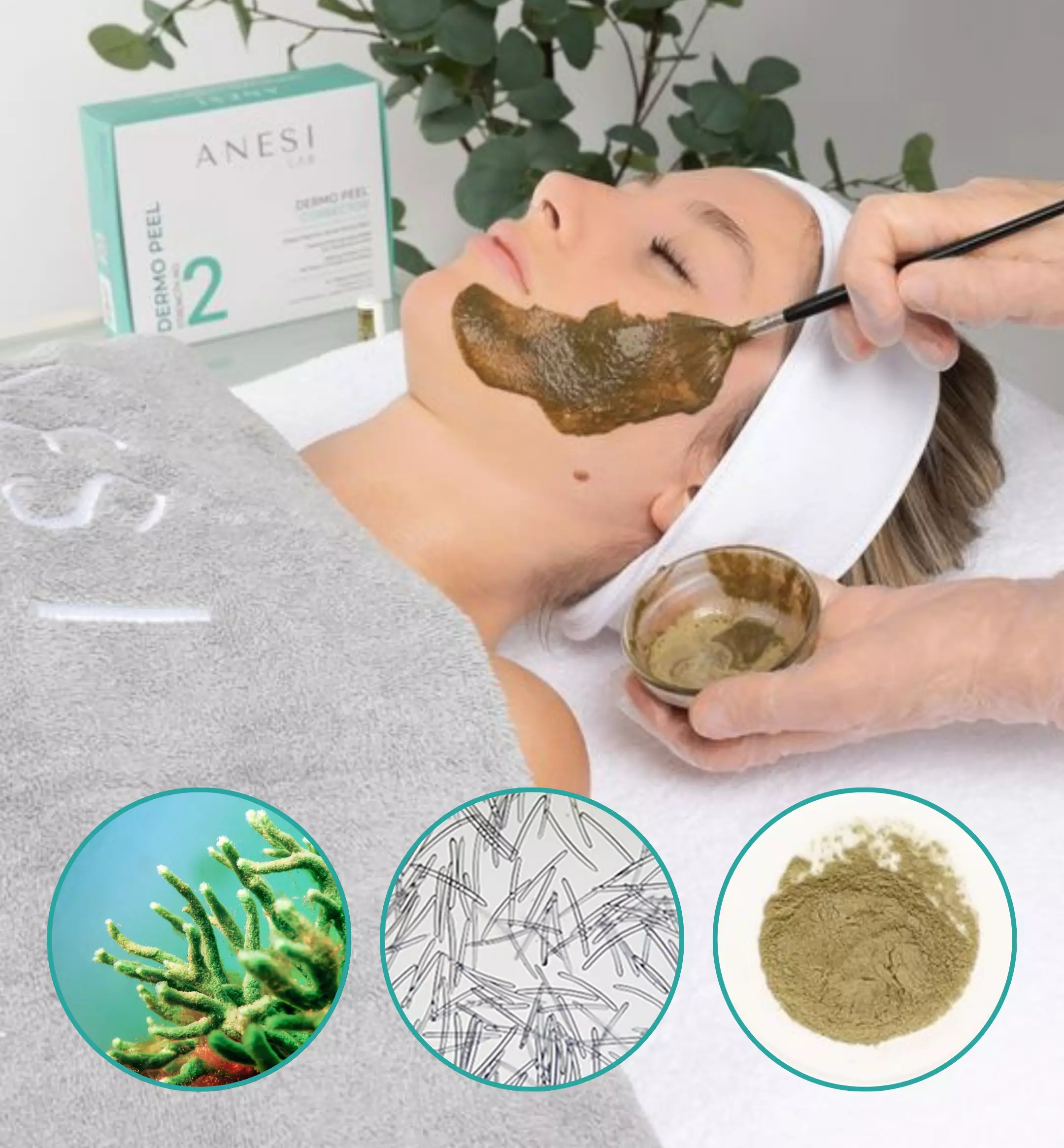
Spicules are microscopic needle-like structures derived from sponges. In skincare, they are typically made up of silica and can measure between 7 to 300μm (0.007-0.3mm) in length.
Where do spicules come from?
Spicules are obtained from freshwater or marine sponges. Sponges naturally produce spicules which can be isolated and purified for use in cosmeceutical products.
Are spicules vegan?
The strict answer is no, but those following a vegan lifestyle may be comfortable with using spicules. Many modern vegans are more concerned with the ethics of a product – such as whether something is sentient, can feel pain, or be exploited, as well as the environmental impact.
Sponges belong to the Animal Kingdom, so are typically considered to be non-vegan. However, as an ancient species, sponges are one of the simplest animals on earth. Sponges are thought to be about 635 million years old, and sponges as we know them today haven’t changed much in the last 550 million years.
Fully grown sponges are not capable of movement, have no brain, circulatory system, or nervous system. This makes them distinct from other animals and some specialists suggest that they be reclassified in a new category, removing them from the animal kingdom.
If you have a client who is unsure whether they feel comfortable using spicules, the best approach is to advise them that spicules are derived from sponges and allow them to make their own decision.
What makes spicules different from other exfoliants?
Spicules are much more than a skin resurfacing treatment. Alongside effective exfoliation, spicules create thousands of tiny microchannels in the skin which allow for more effective absorption of active ingredients, and the absorption of larger molecules such as hyaluronic acid.
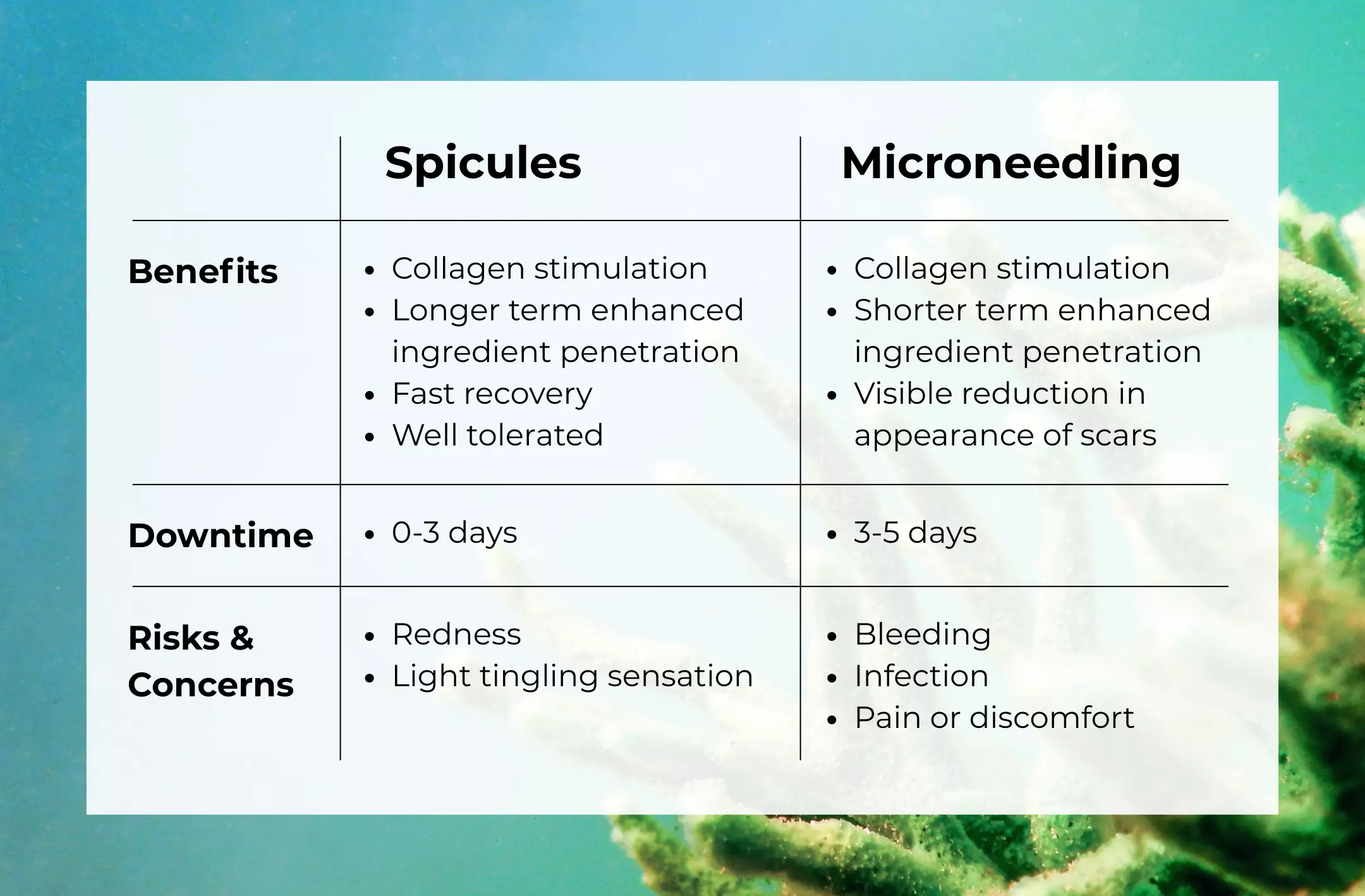
The downtime from a spicule treatment is much faster than an AHA chemical peel, with a shorter period of redness and peeling, is more well-tolerated, and appears to have a similar regenerative efficacy.
How do spicules work?
The tiny needle-like spicules are applied topically. As they are gently pressed into the skin, spicules provide mechanical exfoliation and begin to penetrate the stratum corneum.
Microchannels are formed throughout the skin which allows for active ingredients to penetrate more effectively. Thousands of microchannels are created throughout the treated area. They are distributed evenly and invisible to the naked eye.
Spicules remain in the skin for up to 72 hours, and the microchannels remain accessible for around 120 hours. This allows for skincare actives to continue to penetrate, with large reservoirs accumulating for increased skincare effects.
How do spicules compare to microneedling?
How do you apply spicule formulas properly?
It’s very important to note that spicules are intended to be pressed into the skin and not rubbed on the surface. If they are applied like a typical skin scrub, they will not penetrate as effectively, the skin may become irritated, and the results will likely be much lesser.
Using your fingertips and gentle pressure, make small circular motions. The aim is to maintain contact with the same points on the skin throughout the movement to avoid rubbing. Depending on the formula and purpose of the particular spicule product, you may apply it to the entire face or just to localised areas.
What benefits can spicules provide?
- Enhanced penetration of active ingredients, including molecules usually too large to effectively absorb into the skin like peptides, PDRN, and hyaluronic acid
- Physical exfoliation
- Stimulation of collagen production & skin renewal processes
- Improved skin texture
- Improved skin brightness
What can spicules be used for?
In beauty & aesthetics, spicules are mainly used for:
- Anti-ageing
- Hyperpigmentation
- Acne & blemish treatments
- Skin renewal treatments
- Enhancing product penetration
- Hair loss treatments
Many retail products are also available containing spicules that can help to maintain and enhance treatment results at home.
How deep do spicules reach?
The length of the spicule is one of the key factors in determining how deep they reach into the skin. Spicules typically appear to penetrate the skin between about 25-55% of their length. This is likely because spicules will penetrate the skin at a variety of different angles, rather than going in straight like a needle and the skin is an effective barrier.
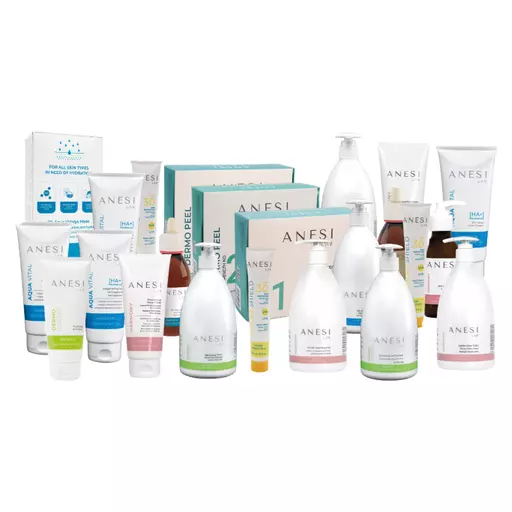
Spicules of 200-250μm in length are commonly used (such as those found in the Anesi Lab Dermo Peel kits) and have been recorded at 100-150µm (0.1-0.15mm)
What do spicules feel like?
As the spicule formula is gently massaged into the skin, most clients tend to feel a mild tingling or prickly sensation in the immediate area being treated.
This light sensation usually continues for a very brief period following the treatment and can sometimes be felt over the next day or so when the treated area is touched.
Which skincare ingredients pair well with spicules?
Ingredients should be selected according to the skin concerns of the individual client. It’s also important to consider the function of the ingredient and if it is designed to work at a deeper level. Common active ingredients that are used alongside spicule treatments include:
- PDRN
- Hyaluronic Acid
- Tranexamic Acid
- Peptides
- Growth Factors
- Vitamin C
- Niacinamide
Combining spicules with formulas with actives encapsulated in exosomes, liposomes, and other carriers can greatly increase the absorption of the active.
What happens to spicules after a treatment?
After a few days, spicules will shed naturally along with skin cells as part of the natural renewal process. Spicules tend to stay in the skin for up to 72 hours after application with microchannels remaining open for up to 120 hours.
Spicules used for medical and cosmetic purposes are mesoporous silica (silicon dioxide) structures, meaning they are covered in lots of tiny pores or holes. While standard silica isn’t biodegradable, tiny porous silica structures or particles are biocompatible and biodegradable, and have been studied for various medical applications since the 90’s.
Confusion and misinformation online around the idea that spicules could stay lodged in the skin and cause problems is widespread. However, sponge spicules specifically are being explored for their potential to deliver cancer combatting drugs and needle-free anaesthetics and current studies indicate that spicules can be entirely broken down and absorbed by the human body making them safe, non-toxic, and highly biocompatible.
Spicule risks
Current research into spicules for cosmetic applications have shown that they are well tolerated and appear to be highly biocompatible. Studies have shown that the skin returns to normal after a few days following spicule application, do not cause significant irritation, and have a good safety profile. This innovative transdermal delivery system and exfoliant is still relatively new and is being studied more and more every year.
Some potential risks include:
- Persistent inflammation in highly reactive skins (spicules are not advised for clients with reactive and sensitive skin)
- Poor client management following treatments
- Over-exfoliation, particularly in home-care products
- Lack of sun protection following treatment
References
Rusanovschi, V. (2025). Water sponge spicule peeling - emerging trends in modern cosmetology. Universitas Europaea: Towards a KnowledgeBased Society Through Europeanisation and Globalisation, pp.573–576. doi:https://doi.org/10.54481/uekbs2025.54.
Mou, D., Yang, M., Jia, M., Liu, Y., Chen, J., Xiao, X. and Chen, M. (2026). Enhanced skin delivery of biomacromolecules using hollow sponge spicules. Bioengineering & Translational Medicine. doi:https://doi.org/10.1002/btm2.70149.
Han, Y., Yang, Z., Xia, W. and Wu, C. (2025). Marine silicon for biomedical sustainability. BMEMat, 4(2). doi:https://doi.org/10.1002/bmm2.70054.
Maimunah, S., Febriyanti, A.P., Fauziyah, B. and Agus, A.S.R. (2025). A Literature Review on Spicule-Assisted Transdermal Delivery Systems (S-TDS) : Penetration Mechanistic and Translational Perspectives. Ad-Dawaa’ Journal of Pharmaceutical Sciences, [online] pp.137–155. doi:https://doi.org/10.24252/djps.v8i2.62569.
Maimunah, S., Febriyanti, A.P., Fauziyah, B. and Agus, A.S.R. (2025). A Literature Review on Spicule-Assisted Transdermal Delivery Systems (S-TDS) : Penetration Mechanistic and Translational Perspectives. Ad-Dawaa” Journal of Pharmaceutical Sciences, [online] pp.137–155. doi:10.24252/djps.v8i2.62569.
Zhang, C., Yang, P., Lin, X., Lai, H., Liu, Y., Yu, S., Liu, T., Chen, M. and Huang, Y. (2025). Topical delivery of Lidocaine using spicules for local anesthesia. Drug Delivery and Translational Research, 16(8), pp.2846–2857. doi:10.1007/s13346-025-02030-4.
Liang, X., Zhang, J., Zhang, C., Zhai, H., Yang, P. and Chen, M. (2024). Mesoporous silica coated spicules for photodynamic therapy of metastatic melanoma. Journal of Nanobiotechnology, 22(1). doi:10.1186/s12951-024-02471-y.
Zhang, C., Zhang, K., Zhang, J., Ou, H., Duan, J., Zhang, S., Wang, D., Samir Mitragotri and Chen, M. (2019). Skin delivery of hyaluronic acid by the combined use of sponge spicules and flexible liposomes. Biomaterials Science, 7(4), pp.1299–1310. doi:10.1039/c8bm01555d.